Guidelines, programme formats, Ethics and Professional Checklist and submission steps
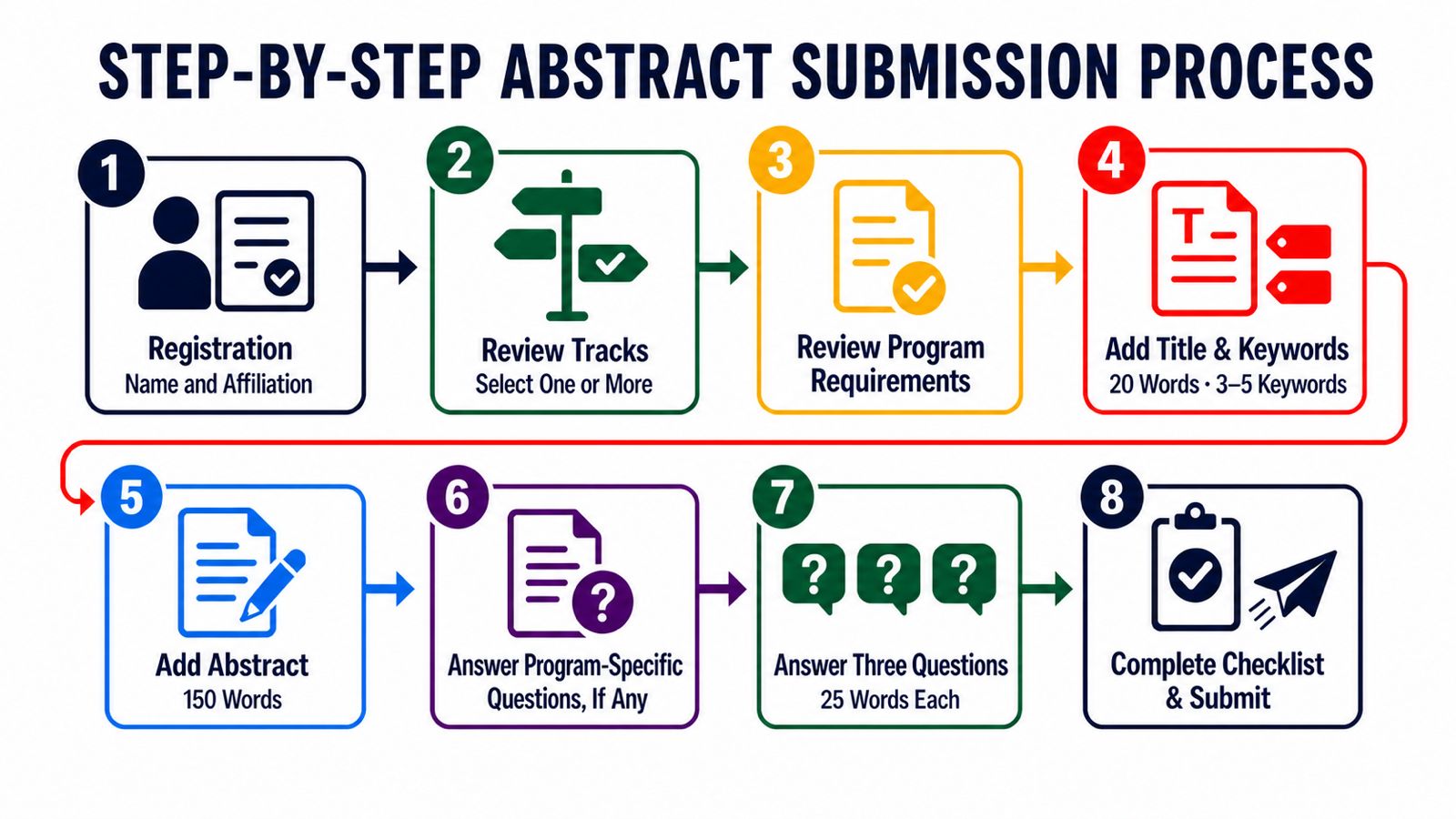
Follow this simple step-by-step process to prepare and submit your abstract for the 10th IPPA World Congress on Positive Psychology.
All submissions to World Congress 2027 Signature Programs must include the following information.
Provide a clear, concise, and informative title that reflects the submission's central topic or contribution.
Maximum: 20 words
Provide an abstract that summarizes the proposed presentation and its relevance to human flourishing. The abstract should clearly identify:
For research submissions, clearly distinguish completed findings from preliminary or anticipated results. Do not include confidential, identifying, or unnecessarily sensitive information.
Maximum: 150 words
Provide three to five keywords that describe the submission's principal topics, populations, disciplines, methods, settings, cultural contexts, or areas of application.
Required: 3–5 keywords
Select the primary scientific track most closely connected to your submission. You may select up to two additional tracks, for a maximum of three tracks in total.
If your submission does not fit clearly within Tracks 1–9, select Track 10: Expanding the Horizons of Flourishing Science—Emerging, Interdisciplinary, and Underrepresented Areas of Research and Practice.
Primary track: Required
Additional tracks: Optional; select up to two.
Please review the following three questions before drafting your abstract. Your responses should add information not already presented in the abstract, and each response should address a distinct aspect of your submission.
Provide brief responses or bullet points; full sentences are not required. Each response must not exceed 25 words.
What is original or distinctive about your submission? How is it informed by empirical evidence, practice-based knowledge, professional expertise, cultural or community knowledge, or lived experience?
Maximum: 25 words
What are the three most important ideas, insights, skills, or practical lessons the audience will take away from your presentation?
Maximum: 25 words; three brief bullet points encouraged
How will you engage an interdisciplinary and international audience through participation, reflection, discussion, application, or exchange?
Maximum: 25 words
Each submission will be evaluated by at least two reviewers independently. Reviewers will assess the abstract and the responses to the three questions.
The maximum score from each reviewer is 25 points:
The presentation title, keywords, and Congress track selections are required but will not be scored separately.
Reviewers should assess the abstract's clarity, coherence, relevance to human flourishing, quality of supporting evidence or knowledge, and significance of the proposed contribution.
Each response to the three questions will be rated independently using a 0–5 Likert-type scale and question-specific criteria:
Each reviewer will assign a score out of 25. The submission's preliminary score will be calculated by averaging the total scores provided by all assigned reviewers.
Maximum preliminary score: 25 points
This checklist applies to all Signature Program submissions and presentations. The submitting author confirms compliance on behalf of all authors, presenters, facilitators, panelists, and contributors.
With the generous support of our Premier Sponsor, Üsküdar University, we plan to offer at least 50 bursaries of up to US$1,000 each to help cover travel and registration expenses. The bursaries are intended to reduce financial barriers and broaden participation in the 10th IPPA World Congress on Positive Psychology, particularly among delegates from the Global South and students worldwide.
You may apply if you are:
All applicants must:
For applicants from the Global South, eligibility will normally be determined by current primary residence rather than nationality or citizenship.
IPPA recognizes that country-based classifications may not adequately reflect every individual’s circumstances. Applicants who are not students and do not meet the standard country-based criterion may request individual consideration if they:
Meeting the eligibility requirements does not guarantee a bursary. Awards will be determined by financial need, available institutional support, geographic representation, career stage, contribution to the Congress, and the available budget.
Requests for support and assessments of eligibility will be considered only after the scientific review process is complete. Applying for financial support will have no influence on the review or acceptance of an abstract.
Explore the 10 signature programs available for abstract submission.
These interactive sessions introduce evidence-informed practices that participants can experience, examine, and adapt. Proposals should combine a concise evidence base with active learning, practical application, and critical reflection.
Topics may address clinical practice, education, coaching, workplaces, healthcare, public systems, community programs, technology, the arts, or other approaches to flourishing.
We especially encourage submissions from the Global South and other underrepresented regions, as well as practices developed, adapted, or implemented across diverse cultural settings.
Submissions are welcomed from:
Sessions should include the following elements, as appropriate:
The Wellbeing Intervention Showcase invites practitioners, researchers, educators, students, and program developers to demonstrate how a focused intervention addresses a clearly defined everyday wellbeing challenge.
Each presentation should identify:
Interventions should have a credible foundation in research, professional experience, cultural or community knowledge, or lived experience. Presenters should demonstrate what the intervention involves, why it is appropriate, and what meaningful difference it may make.
Submissions may feature interventions:
Interventions may be situated in clinical, health, educational, workplace, organizational, family, community, public-system, digital, cultural, or other applied settings.
This showcase supports focused contributions from individuals or small teams. We especially encourage interventions developed, adapted, or implemented in the Global South, underrepresented regions, and diverse cultural and Indigenous settings.
Submissions may address challenges such as:
These examples are illustrative, not exhaustive. Applicants may identify other specific problems affecting wellbeing in everyday life.
Submissions are welcomed from:
Within the 10-minute format, presenters are encouraged to demonstrate the intervention or one of its essential components rather than relying exclusively on a conventional lecture.
Science Meets Practice Panels connect researchers with practitioners, policymakers, educators, organizational leaders, community representatives, cultural knowledge holders, and people with lived experience. These moderated sessions examine how flourishing research can inform responsible real-world action.
Panels may explore implementation, cultural adaptation, accessibility, ethics, equity, feasibility, scalability, evaluation, costs, barriers, and unintended consequences. We especially encourage panels incorporating Global South, Indigenous, cross-cultural, and other underrepresented perspectives.
A Focused Flourishing Symposium brings together complementary perspectives on one clearly defined topic related to human flourishing.
Proposals may integrate:
The presentations must make distinct but complementary contributions to one coherent session. A symposium should not be a collection of loosely related presentations.
Each symposium is a 60-minute session consisting of:
The symposium chair is responsible for creating, coordinating, and submitting the complete proposal.
Applicants must select one category:
The symposium chair is responsible for preparing, coordinating, and submitting the complete proposal.
A symposium proposal is not complete until:
Features compelling and ethically presented accounts of flourishing in real life. We welcome personal and community stories, as well as case studies.
Submissions may explore experiences such as:
We welcome personal and community stories, as well as case studies from:
Multidisciplinary case studies may demonstrate how different professions, disciplines, communities, or sectors worked together to understand or respond to a challenge related to flourishing.
Cross-cultural, Indigenous-led, and community-partnered submissions are especially encouraged. These submissions may emphasize local knowledge, cultural traditions, lived experience, community priorities, and diverse understandings of flourishing.
A submission should offer more than an inspirational story or a description of an experience. It should communicate a meaningful:
Applicants do not need academic credentials or formal research findings. However, the submission should make clear what the audience can learn from the experience or case.
Submissions are welcomed from:
Academic credentials are not required. Collaborative submissions are encouraged when appropriate. Please do not include confidential, identifying, or unnecessarily sensitive personal information in the abstract.
All submissions must protect privacy, obtain appropriate consent, represent individuals and communities respectfully, acknowledge contributors and knowledge ownership, and distinguish documented outcomes from personal interpretation or anticipated impact.
Invites concise visual and documentary works that communicate the science, practice, culture, and lived experience of flourishing to specialist and general audiences.
Submissions may document research, interventions, community initiatives, cultural knowledge, innovations, or personal experiences in authentic settings. Films may incorporate interviews, observational footage, narration, animation, archival material, research findings, artistic elements, or demonstrations.
Visual storytelling must be central to the submission. Recordings of conventional lectures or slide presentations will not be accepted.
Submissions are welcomed from:
Each selected submission must have at least one designated presenter attend the Congress in person.
Up to three selected works may receive Audience Engagement Recognition, based on feedback collected following eligible screenings and discussions.
The Early Career Investigator Competition invites researchers who completed their doctorate within the seven years preceding the submission deadline to present high-quality, original research specifically focused on flourishing. Submissions should have the potential to advance understanding of flourishing and influence future scholarship, policy, or practice.
The competition enables early career investigators to share their flourishing-related research with an international audience, demonstrate their independent contribution, receive feedback, and gain recognition.
Applicants must submit an abstract describing their flourishing-related research and answer three questions through the regular abstract submission process. Submissions will undergo scientific review, with selected applicants advancing to the final round.
Finalists will deliver a 15-minute, live, in-person presentation as part of the Congress's main program, followed by a question-and-answer period. A panel of judges will evaluate each presentation using established criteria. Based on the judges' scores, the highest-ranked finalist(s) will receive an Early Career Investigator Award.
The Student Research Competition invites undergraduate, graduate, and postdoctoral researchers to present high-quality, original research focused on human flourishing and related to one or more Congress tracks. Submissions should have the potential to advance understanding of flourishing and influence future scholarship, policy, or practice.
The competition enables emerging researchers to share their work with an international audience, receive feedback, demonstrate their contributions, and gain recognition.
Applicants must select the category that reflects their academic or training status at the submission deadline:
Applicants must submit an abstract describing their flourishing-related research and answer three questions. Submissions will undergo scientific review, with selected applicants advancing to the final round.
Finalists will deliver a 15-minute, live, in-person presentation as part of the Congress's main program, followed by a question-and-answer period. A panel of judges will evaluate each presentation using established criteria. Based on the judges' scores, the highest-ranked finalist(s) in each category will receive a Student Research Award.
Based on the judges' scores following the live, in-person presentations, the highest-ranked finalist(s) in each competition category will receive a Student Research Award. Award recipients will be recognized during the Congress and through its official communications.
Poster Presentations provide a concise, visually engaging format for sharing research, practice, interventions, case studies, community initiatives, theoretical developments, and emerging ideas related to human flourishing.
Posters are especially suited to work that benefits from focused discussion and direct interaction with Congress participants. Submissions may present completed or preliminary research, evaluation findings, practice-based knowledge, culturally grounded perspectives, lived experience, or work in progress. The status and limitations of the work must be clearly identified.
Submissions are welcomed from:
Poster submissions follow the standard requirements for Congress programs:
1. Original and Informed Contribution
What is original or distinctive about your submission? Explain how its contribution is informed by empirical evidence, practice-based knowledge, professional expertise, cultural or community knowledge, or lived experience, as applicable.
2. Three Key Audience Takeaways
What are the three most important ideas, insights, skills, or practical lessons that participants will take away from your poster?
3. Audience Engagement
How will you use the poster and accompanying discussion to engage an interdisciplinary and international audience?
At least two reviewers will score each submission out of 25 points:
The preliminary score will be the average of all assigned reviewers' scores.
Accepted posters should clearly present:
Research posters should distinguish completed findings from preliminary or anticipated results. Practice and community-based posters should distinguish evaluated outcomes from professional experience, community knowledge, or proposed impact.
Presenters must confirm that:
From Knowledge to Action for Human and Planetary Flourishing
Invite multidisciplinary teams to propose a credible, evidence-informed and actionable response to a challenge affecting human, community, societal or planetary flourishing. The strongest submissions connect knowledge with implementation and give affected communities a meaningful role in defining the challenge, shaping the response and judging success.
Prepare the submission collaboratively. Claims should match the strength of the evidence, and limitations, risks and uncertainties should be stated clearly. Personal disclosure of lived experience is always optional.
Selected teams: Up to six teams may be invited to deliver a 40–50-minute Congress session, respond to feedback, prepare a concise Global Solutions Action Brief and identify practical next steps. Limited competitive travel support may be offered separately to eligible students and team members based in the Global South
1.1 Submission type (REQUIRED)
Select the one option that best describes the proposal.
1.2 Proposal title (REQUIRED • 30 words max)
Use a specific, plain-language title that signals both the challenge and the proposed response.
1.3 Plain-language summary (REQUIRED • 100 words max)
In accessible language, state the challenge, proposed solution or next step, and expected contribution.
1.4 Keywords (REQUIRED)
Enter 5–7 searchable keywords.
Select one primary track. You may select up to two additional tracks; do not repeat the primary track.
Primary track number / Additional track number(s)
3.1 Challenge and significance (REQUIRED • 150 words max)
Define the challenge, who is affected, how it limits wellbeing or opportunities to flourish, and why it matters now.
3.2 Multidisciplinary solution (REQUIRED • 250 words max)
Describe the proposed solution, adaptation or testable next step. Explain how distinct disciplines, sectors, cultures or forms of expertise shape the work; how community or lived-experience partners will participate; and which dimensions of flourishing the response addresses.
4.1 Evidence and innovation (REQUIRED • 200 words max)
Summarize the research, practice, policy, cultural, community and/or lived-experience knowledge that supports the proposal. Distinguish what is established, plausible and uncertain, and explain what is new about the approach or its application.
4.2 References (OPTIONAL • Up to 5 references or 150 words)
Use any consistent citation style. References are excluded from the 1,400-word narrative total.
4.3 Implementation and evaluation (REQUIRED • 300 words max)
Explain who will deliver and govern the work; the setting, sequence and resources; and how equity, cultural relevance, accessibility, safety, workforce capacity, cost and sustainability will be addressed. Identify expected outcomes and measures, important risks or unintended effects, decision points, and the conditions under which the work could—or should not—be scaled.
5.1 Session concept (REQUIRED • 150 words max)
Show how the proposal will become an engaging 40–50-minute session. Explain how multidisciplinary, cultural, community and lived-experience perspectives will be integrated and how participants will contribute to learning and future collaboration.
5.2 Participant engagement (REQUIRED)
Select all that apply.
6.1 Missing expertise or partnerships (REQUIRED • 100 words max)
Identify capabilities, perspectives, relationships or partners still needed to strengthen the work.
6.2 Support requested (OPTIONAL)
Committee assistance is subject to availability and does not guarantee selection.
Add, remove or reorder team members as needed. Identify one member as the team lead and primary contact. Personal lived or community experience may be disclosed voluntarily; it is not required.
Use additional copies of this page for teams with more than four members.
8.1 Team integration statement (REQUIRED • 150 words max)
Explain why each member’s contribution is necessary, how perspectives will be integrated, and how the team will share decisions—including with community or lived-experience partners.
8.2 Perspectives represented (REQUIRED)
Select at least three. Applicants are not required to disclose personal lived experience.
All boxes are required.
9.1 Conflict of interest (REQUIRED)
Does any actual, potential or perceived conflict of interest need to be declared?
Narrative word budget
Excluded from the total: title, keywords, references, team-member details, declarations and short administrative fields.
Review criteria
Each criterion is scored on a five-point scale.
Final submission check
Details to follow
The Congress could offer a series of intensive master classes led by prominent positive psychologists. These sessions would provide participants with direct access to leading scholars and practitioners while integrating current research, practical frameworks, demonstrations, case studies, and experiential learning.
 Presenting Sponsor
 Premier Sponsor